The Civil War era was marked by its profound challenges and hardships, which extended beyond the battlefields to impact the lives of civilians as well.
Without modern medical advancements, many individuals turned to nature’s healing powers.
Drawing from the wisdom of the past, let’s delve deeper into the world of natural remedies prevalent during the Civil War era.
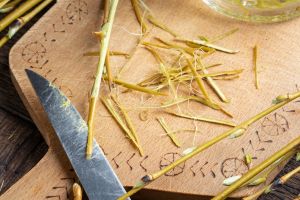
As the cannons roared and soldiers faced minor and severe injuries, willow bark emerged as a potent remedy for pain relief. This natural analgesic contained salicin, a compound similar to the active ingredient found in aspirin.

Soldiers chewed on willow bark or brewed it into teas to alleviate headaches, muscle aches, and discomfort. The efficacy of this simple remedy showcased the power of plants to ease suffering.
With unsanitary conditions prevailing on and off the battlefield, digestive problems were rampant.

Slippery elm offered relief as a gruel. Derived from the inner bark of the slippery elm tree, this gruel was consumed to ease symptoms of diarrhea, heartburn, and gastritis.
Its gentle nature and effectiveness made it a go-to remedy for those battling digestive distress, both on the battlefield and afterward.
For centuries, Native American tribes possessed a profound understanding of the remarkable immune-boosting properties inherent in echinacea

This vibrant flowering plant gained popularity during the Civil War era for its ability to fortify the body’s defenses against illnesses.
Echinacea was consumed in teas or tinctures to alleviate symptoms of colds, flu, and infection. Its enduring reputation as an immune-supporting herb continues to this day.
My advice would be to cultivate your own echinacea flowers at home. This way, you’ll have a constant and accessible supply of their immune-boosting benefits right at your fingertips.
While many plants were used to treat infection and pain during the Civil War, the Devil’s Walking Stick seemed the most effective and easiest to obtain.

Devil’s Walking Stick, a prominent member of the ginseng family, is renowned for its ability to grow up to a height of 30 feet on occasion.
Abundant across much of North America, the Devil’s Walking Stick was a popular treatment during the Civil War. Tincture brewed from the berries of this plant is known to ease the pain from a toothache and help with rheumatic pain.
Furthermore, Devil’s Walking Stick has been shown to inhibit the growth and spread of some types of infections, specifically staph infections.
In the absence of modern wound care treatments, soldiers often faced the risk of infection from battle injuries.


Calendula, or marigold, emerged as a vital natural remedy for wound healing. Its anti-inflammatory and antiseptic properties make it an ideal ingredient for creating healing salves.
Calendula salves were applied to wounds, burns, and skin irritations, promoting faster healing and minimizing infection risk.

The challenges of wartime travel often led to nausea and motion sickness, making long journeys even more arduous.
With its natural anti-nausea properties, ginger emerged as a comforting and reliable remedy to combat these discomforts.
Soldiers and civilians relied on ginger tea or chewed ginger root to ease queasiness and settle their stomachs during journeys.
Today, ginger is still a staple for treating an upset stomach and is found in many common medications.
Respiratory ailments were a common concern during the Civil War, and mustard plasters were a popular natural remedy to alleviate congestion. A mixture of mustard powder and flour was applied to a cloth and placed on the chest.

This remedy caused the skin to redden and brought relief by stimulating blood circulation and helping to clear congestion.
For centuries, the use of cabbage in treating arthritis pain has been well-documented.

Cabbage is renowned for its remarkable anti-inflammatory properties. Therefore, cabbage proves to be exceptionally beneficial in treating arthritis pain and providing relief from joint discomfort.
One popular treatment method is to create a cabbage leaf wrap and apply it to the affected joint.
Sage held a special place as a reliable remedy during the Civil War era. It was often turned to for its ability to provide comfort and relief, particularly for sore throats.

Creating a sage gargle was a common practice – a simple method that involved steeping dried sage leaves in hot water.
This concoction was cherished for its effectiveness in reducing inflammation and soothing the discomfort that accompanied a sore throat.
This humble remedy, born from the wisdom of the time, played a valuable role in alleviating the everyday ailments of that era.
Witch hazel, a plant known for its potent astringent and anti-inflammatory qualities, had long been a favored remedy for soothing an array of skin irritations and discomforts.

An infusion of witch hazel leaves or bark was applied topically to alleviate itching, inflammation, and minor wounds.
The Civil War era’s reliance on natural remedies underscores the enduring wisdom of utilizing nature’s offerings for health and well-being. From willow bark to ginger and beyond, these remedies provided relief and comfort in times of immense hardship.
The natural remedies utilized during the Civil War era reflect the resourcefulness and practicality of a time when medical options were limited—the creative treatments of this period aimed to alleviate common health issues faced by soldiers and civilians alike.
While modern medicine has made significant strides since then, these historical remedies remind us of the enduring power of nature in providing relief and healing. They also offer a window into the past, showing how people creatively used the resources available to care for their well-being.
Despite a constantly evolving world that has come a long way since the Civil War, these remedies serve as a testament to the age-old relationship between humans and our natural environment and remind us how truly blessed we are to live on this planet.
I would love to hear about your favorite folk remedies or experiences in the comments section. Stay Safe.
It’s time to take a more inquisitive approach to the contents of our meat. For, the seemingly innocuous juicy burger or tender steak that you indulge in may now have a new, potentially harmful ingredient. It’s not a novel seasoning or additive; it’s a cutting-edge biotechnology phenomenon — mRNA vaccines.
Ever since their successful application in human healthcare, mRNA vaccines have been on the radar of pharmaceutical giants such as Pfizer and Bayer. Now, their target is shifting from Homo Sapiens to the broader animal kingdom — the farm animals that eventually find their way to our plates. The projected scale of mRNA implementation in the livestock industry is unprecedented and raises an alarm for consumers everywhere.
The nitty-gritty of mRNA vaccines’ effects on humans is increasingly studied and discussed, but what remains elusive is the potential impact on those consuming meat from mRNA-vaccinated animals.
Can these animals produce toxic proteins that infiltrate the meat we consume?
And if so, what implications does it hold for our health?
Various reports suggest that mRNA vaccines, once administered, circulate throughout the body, influencing different organs and the bloodstream. The capacity to induce the production of potentially toxic proteins and trigger harmful consequences is known. But what sends chills down the spine is the fact that these substances can clog arteries, leading to fatal consequences such as strokes and heart attacks.
Moreover, their power to alter chromosomes and incite permanent genetic changes in the organism remains an undeniable concern.
What further stokes the fire of apprehension is the various ways these mRNA instructions can enter the human body. Contrary to popular belief, injections aren’t the only culprits; these substances can also be ingested or absorbed through skin contact. The innocent act of handling raw meat could expose one to the risk of “shedding,” much like vaccine recipients.
And this risk doesn’t end there. It extends to the very act of savoring your favorite meat dish. Introducing mRNA-vaccinated meat products, even partially cooked, into your mouth may expose you to a peculiar kind of “food shedding.” It potentially allows the absorption of these alien proteins into your blood and their subsequent circulation throughout your body.
If this unnerves you, consider the fact that this isn’t a speculative horror story from the distant future. Companies have already announced their plans for mRNA vaccines for meat animals. In a recent article, Dr. Robert Malone reveals Big Pharma’s intent, with such declarations dating back to 2016. Some of these include Bayer’s partnership with BioNTech for mRNA vaccines and drugs, SEQUIVITY’s custom swine vaccines, and even a Foot and Mouth Disease mRNA Vaccine deal signed between the NSW Government and Tiba Biotech.
The overarching implications of these developments are truly horrifying. The influx of mRNA vaccines into the ranch animal industry could potentially wipe out a considerable number of animals due to health complications, simultaneously contaminating the meat supply. It’s hard not to see this as a deliberate effort to control food supplies and shift dietary norms.
In such a scenario, knowing your meat’s origins becomes crucial. Factory animal operations are likely to be mRNA-biotech hotspots. While it’s hypothesized that high-heat cooking might neutralize some mRNA-induced proteins, the risk of consuming raw or partially cooked meat from such sources is not worth taking. Thus, we urge you to patronize local, holistic meat providers, or consider adopting vegetarian dietary practices.
Amidst these dire projections, it’s impossible to ignore the role of globalists, seemingly keen on replacing meat with alternatives like grubs, mealworms, and black soldier fly larvae. A recent study hints at mealworms replacing chicken in nuggets, an unappetizing vision for many. Yet, while the masses are being primed for insect protein, the elites continue to enjoy organic, non-GMO food — a stark illustration of the widening divide in our society.
As these developments unfold, it’s time to pay heed to what lies on our plates.
For, what we eat isn’t just a question of taste anymore — it’s a matter of survival.

In an age where technology dictates life, the devil, often enough, lurks behind the face of genius. The existential threat humanity is facing is far more complex, insidious and perilous than nuclear warfare, as one such individual, hidden behind his philanthropic facade, appears to be playing God.
Bill Gates, a familiar figure revered in the echelons of globalist circles, is embroiled in a sinister narrative. His technocratic and transhumanist ideologies have already wreaked havoc on existing systems of civilization, inciting multiple health disasters. Nevertheless, his influence and dominance remain undisputed, casting a long and disconcerting shadow on our future.
Enter Rand Paul, the candid Senator, who recently teed off on Gates in a Fox News appearance, taking a hammer to the billionaire’s eccentric passion for virus-related research. He pulled no punches when it came to putting Gates’ suspicious activities into perspective.
Paul, with an alarmingly direct approach, stated, “Bill Gates is the largest funder of trying to find these viruses in remote caves and bring them to big cities.” This method, known as gain of function research, is nothing short of playing Russian Roulette with humanity’s existence.
In his recount of the dire scenario, Paul continued, “They went eight to 10 hours south of Wuhan, two to 300ft deep into a cave, found viruses, and took them back to a city of 15 million.” This hazardous investigation brings viruses we might never interact with into our cities, potentially igniting pandemics, with the COVID outbreak being a case in point.
While Paul didn’t mince words about Gates’ involvement, he also highlighted the discontent brewing in the scientific community. “Many scientists think that Bill Gates is wrong in funding this. We don’t need to be searching for viruses that may never interact with man.” An argument that holds significant weight considering the unprecedented damage and loss caused by the ongoing pandemic.
Paul’s damning indictment doesn’t stop there. Gates, as per him, is responsible for introducing viruses into labs, where they are combined with others to create Frankenstein-like pathogens unseen in nature. “But this has largely been funded by Bill Gates. He funds the WHO more than most countries do,” Paul asserts, pointing to Gates’ disproportionate power and influence over global health.
The Senator’s stand echoes reporting by Michael Shellenberger and Matt Taibbi that suggested the first COVID victims were scientists from the Wuhan virology lab. One of them, believed to be the first to contract the virus, was reportedly engaged in creating these novel viruses. If this account holds water, it unveils an alarming reality that substantiates Paul’s bold claims.
The pursuit of truth doesn’t end there. Paul declared his intent to disclose the declassified records to the public, which, if successful, would confirm the origin of COVID from the lab. But this revelation is just the tip of the iceberg. The larger battle is to stop the funding of this dangerous research, not just in China but also in the US.
What the world needs now, according to Paul, is an international consortium of countries that will voluntarily agree to restrict this. A pertinent sentiment, considering the potential of another lab leak wiping out 5 to 50 percent of the population.
The nuclear arms race had humanity living under the constant specter of annihilation. But the danger we face now, as Paul emphatically pointed out, is “much more insidious.” An invisible enemy, manipulated by human hands, may threaten our existence more than any weapon of mass destruction.
The world needs to wake up to the harsh reality and act before it’s too late. As the tale of the tech titan’s disturbing obsession unfolds, we must rally to demand transparency, accountability, and immediate reform.
Today in the United States, fewer than 1 percent claim farming as an occupation, and only 2 percent of Americans live on a farm. In my opinion, this translates to a systemic risk for the 98 percent of people who literally depend on them for their food.
It looks even worse from the following perspective.. Farmers and ranchers themselves make up just 1.3% of the employed US population, totaling around 2.6 million people. That’s just 0.8% of the U.S. population as of this post.
There are various ways to slice this pie. Total ‘agricultural’ related employment numbers don’t look quite as scary, but still… “Agriculture and its related industries provide 10.5 percent of U.S. employment” according to the USDA.
From the standpoint of what I consider to be systemic risk, I’m concerned about the extremely low number of American family farms compared to years past.
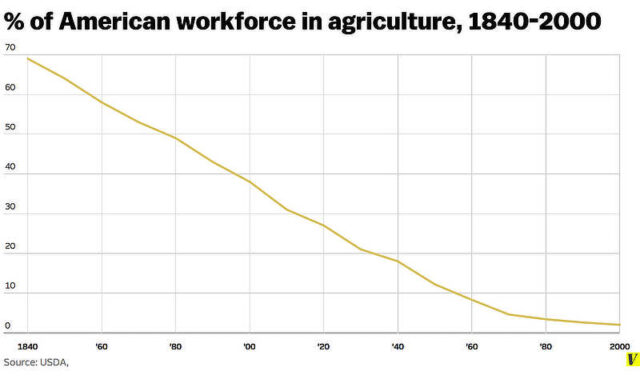
According to data from the USDA, 70% of the American work force worked in agriculture in the year 1840. Whereas in the year 2000, barely 2% worked strictly in agriculture.

What has changed? Well, lots of things.
Technology has enabled scale of efficiencies in farming.
Big farms and corporate farming have swallowed up a tremendous number of small, medium, and family farms – for a number of reasons.
Burdening regulations that only ‘big money’ could deal with, which resulted in many farmers having to sell or face bankruptcy. (It’s not exactly a high margin industry).
Most remaining family farmers are what you might consider to be the older generation. There’s little interest among the young who may find better financial opportunities elsewhere. In America today, the average principal farm operator is 58 years old, nearing the age of retirement.
Whatever the many additional reasons are, the fact is that much our food supply is in the hands of the few – most of whom are ‘big farming’ and/or part of ‘big corporate agriculture’. And they do not necessarily have your best interests in mind.
Don’t get me wrong.. they’re producing lots of ‘food’ (and exports). However the way I see it – this has put most of our eggs in one basket, so to speak.
From the standpoint of prepping & preparedness, I see all this as a fairly significant risk. The risks associated with big-farming / corporate profits versus things like nutrition, sustainability, ‘real food’ (just to name a few).. And think about the great distances involved from farm to table (and the things they have to do (e.g. modifying foods) to overcome this).
Putting the majority power and control of our food supply into ‘big money’, ‘big agriculture’ seems a bit risky to me. In America, the big get bigger and the small go out.
And what about the fact that we’re ‘hooked’ on this system? The family farms are almost essentially gone. As more small farmers give up or give in, there’s quite an impact on rural communities and supporting infrastructure. Much to the glee of big agriculture.
Side note: Did you know that Bill Gates is now apparently the biggest owner of farmland in the United States?
Support local farming. Don’t gripe about the price at a Farmers Market – they have to eat too. Grow your own garden, however big or small. Help out a farmer if you are able. Support community farming / gardening.
Sometimes (within the prepping & preparedness arena) we might hypothesize what would happen under one of many ‘worst case disaster scenarios’. Well, the food department ought to be one of your major priorities. It’s one thing to have plenty stored away. But what about when it runs out and supply chains are essentially non-existent? It will take a functioning community focused on sustainability to overcome. The more small farms around – the better..
Written by Henry D. Walker — April 26, 2026 More and more foreign wars… and this one is being pushed straight against ordinary people, again...